Juma
- Self-denomination
- Where they are How many
- AM 12 (Siasi/Sesai, 2020)
- Linguistic family
- Tupi-Guarani
The Juma belong to a group of peoples, of the Tupi-Guarani language family, called Kagwahiva. In the XVIIIth Century, it is probable that the Juma had a population of between 12 and 15 thousand Indians. After successive massacres and the expansion of extractivist industries, their population was reduced to a few dozen people in the 1960s. In 2002 there were only five individuals left: a father with his three daughters and a granddaughter.
Location
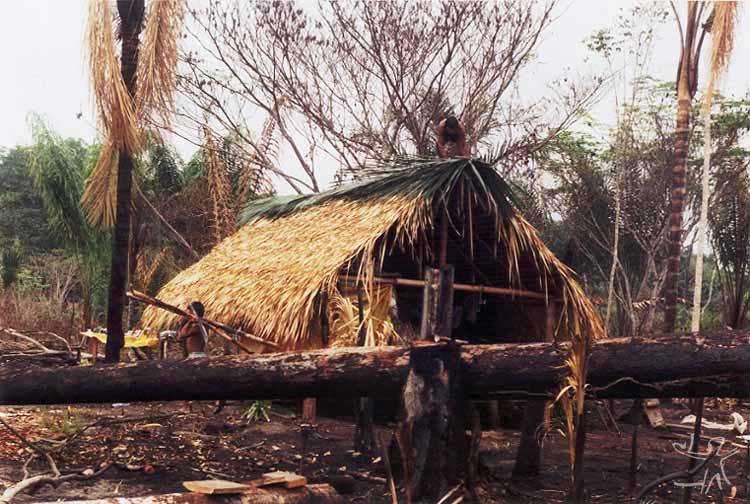
The Juma belong to a group of peoples called Kagwahiva, who, according to the historical records, migrated from the region of the upper Tapajós to the area near the Madeira River (Nimuendajú, 1924; Menéndez, 1981/82). In this migration, the groups fragmented and, today, the Kagwahiva live dispersed over a wide area.
On the upper Madeira, there are the Karipuna, the Uru-eu-wau-wau and the Mondawa; on the middle Madeira, the Tenharim (of the Marmelos river, the Preto stream and the Sepoti), the Parintintin and the Jahui; in the region of the Purus, the Juma. Probably there are still isolated Kagwahiva groups.
The Juma inhabit the region of the Açuã River, near the city of Lábrea, in the southern part of the state of Amazonas. The territory of the group is located in the municipality of Canutama-AM and was demarcated in 1993 with an area of 38,700 hectares and a perimeter of 130 square kilometers. But, until now, the Indigenous Land has not been homologated, in part because of doubts regarding the survival of the people, since their survivors are all related and cannot have children.
The situation became even more complex when, at the end of 1998, the Juma left their lands, being transfered by local Funai employees to the House of the Indian in Porto Velho (Rondônia) and, later, to the upper Jamary village, to live with the Uru-eu-wau-wau, where the father and daughters of the Juma family married individuals of this other ethnic group. At the present time, they still inhabit this village and are in doubt regarding their return or not to their former lands.
History of Contact
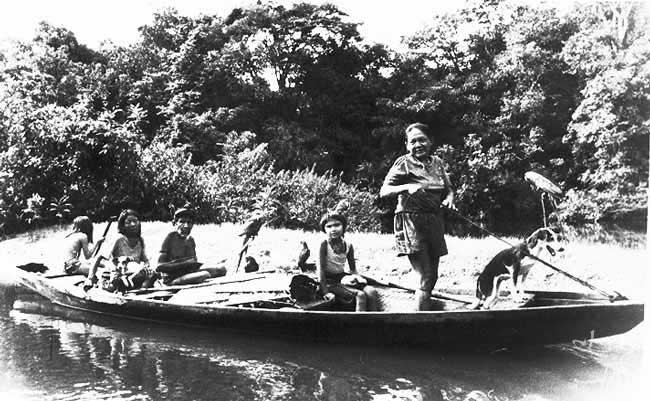
The Kagwahiva groups were mentioned for the first time in 1750, in the region of the upper Juruena River, near the Apiaká. This place was practically unknown to the expansion fronts and later came to be seen as the domain of Língua Geral, alluding to the Tupi-Guarani language spoken by these peoples (Ferreyra, 1752). Later, this area was swept by the mining frontier, which advanced ever further to the north in search of new gold mines (Menéndez, 1989:38). The pressure exerted by this expansion front, as well as the war with the Munduruku, have been cited as the reason for the migrations of the Kagwahiva from this region to the area around the Madeira River(Nimuendajú, 1924:207-208). Tocantins (1877:93), who passed some time among the Munduruku, says that their main enemies were the Parintintin. However, according to Menéndez (1989:47), the existing interethnic dynamics in the region were conditioning factors of this complex migration.
The creation of the Indian Directorates, in 1757, - a period coinciding with the first references to the Kagwahiva, - made the indigenous popultation, settled in villages or not, become incorporated to the colonial system without intermediaries. The policy of Pombal led to an increase in the number of white colonists and greater control over the indigenous population. As a result, there was a reaction to the Directorates and a new definition of Indian policy in the years to follow. In any case, even after the fall of Pombal and until the Independence of Brazil, legislation continued to be anti-Indian (Moreira Neto, 1988:27-30).
Native labor was widely utilized, which generalized conflict in the region. The groups who refused to submit to colonial domination set off on long migrations in the Amazonian territory. In the case of the area located between the Madeira and Tapajós rivers, these conflicts led to the flight and extinction of whole groups who lived on the banks of the major rivers. Consequently, other groups, who lived in the forests, came to occupy the empty spaces, becoming more visible to the chroniclers and travellers who circulated in the region during the 17th and 18th centuries (Ribeiro, 1970:37; Menéndez, 1981/82:350)
The Kagwahiva are a clear example of this, for, after the references on the upper Tapajós, they are recorded in 1817, for the first time by the name of Parintintin. This name, it is supposed, was given by the Munduruku to their enemies. In 1850, both the Kagwahiva and the Parintintin are on record together and, later, the ethnonym Kagwahiva disappears and all of these people come to be called Parintintin (Menéndez, 1989:26). Only after the fieldwork undertaken by Nimuendajú in 1922 was it possible to determine that Kagwahiva is the self-denomination of the Parintintin and that this designation was only applied to one of these people (Nimuendajú, 1924:204-205).
In the region of the Madeira River, the approximation of Kagwahiva groups to Brazilian society took place after an intense war which lasted for nearly 70 years, between the middle of the 19th Century and the 1920s, ending only with the action of the Indian Protection Service (SPI) and the definitive installation of rubber- tapping trails in the region. Curt Nimuendajú was the principal agent in this approximation: hired by the SPI, he organized expeditions and fixed himself up inside the indigenous territory. Due to lack of money from the agency, Nimuendajú abandoned his project after only five months, leaving several assistants in his place. Several years later, one of them, José Garcia de Freitas, had trouble with the number of groups, which he called "warrior clans":
"Tentatively we are aware of nine groups, all enemies amongst themselves, making war and committing the greatest cruelties with their victims. They are the following: Kuandey' (little hawks), Odiahub' (probably the present- day Jiahui), Itauéry', Tucut', Miundê', ´Pain', Apairandê' (the present-day Tenharim), Kôte-Apain', Boritá', a group which today is only comprised of women" (Freitas,1930:7-8).
From what it seems, the diversity of the Kagwahiva peoples in this region was until then unknown: all were considered Parintintin. Nevertheless, the ethnonym of Kagwahiva existed before, and references to them in various different places seem to indicate moves within a vast extent of the Madeira-Tapajós area. Given the characteristics of the social organization of these peoples, one can infer that they lived in small groups spread out throughout the region, making wars and establishing alliances.
In the Purus region, the first records already indicated the Juma as inhabitants of the area. When the effective occupation of the region by non-Indians began, wars against the peoples who resisted also started. As happened generally in Amazônia, peoples were brought into contact and later utilized in the extermination of other indigenous groups.
In the mid-19th Century, a connection between the Purus basin and the Madeira River was sought, in an effort to avoid the rapids along the stretch of this river. At that time, more specific references to the indigenous peoples who inhabited this region began to appear. This search for access to the Madeira River produced a series of reports on the region of the Purus, including its vegetation, climates and population. The main references from this period are Manoel Urbano da Encarnação, who navigated the Purus in 1861, João Marfins da Silva Coutinho, in 1862, e William Chandless, in 1864. There are indications in the sources that non-Indians came to occupy permanently the region of the Purus which, until the mid-19th Century had basically been occupied by the indigenous population (Dal Poz Neto, 1985:12).
The reports by Coutinho (1863; 1865) and Chandless ([1866]1949), present information on the viability of non-Indian occupation of the region, describing its general conditions, the manner of the Indians, the potential of the Indians in the "civilizing" process of the time, which characterized so-called "worker" and "warrior" populations. The Juma were always included in the second category, defending their territory from invasion and avoiding permanent contacts.
Several incidents from this period established a certain kind of action in relation to these people. In 1869, the Juma attacked a couple who lived in this region, which led to the sending of police troops to the locale, for the purpose of avoiding the interruption of extractivist activities. This fact occurred due to the imprudence of a man who fired against a group which demonstrated friendly signs (Mattos, 1870).
The conflicts with the indigenous peoples began to worsen in the second half of the 19th Century, when waves of migration began slowly arriving from the Northeast of Brazil to work in rubber extraction. This is directly related to the growing utilization of rubber by industries from the United States and Europe which reached their apex by around 1910 (Kroemer, 1985; Dal Foz Neto, 1985). To cite Kroemer:
"As a result, indigenous territories diminished drastically, and various societies were completely exterminated. Depopulation invalidated the indigenous systems of production and social organization, forcing dispersion. Punitive expeditions were organized by colonizing firms, navigation companies and land owners, with the approval or even the participation of the repressive power of the province" (Kroemer, 1985:78).
Again, according to Kroemer (1985:80), the most numerous nations of the Ituxi River were the Cacharari, Canamari, Guarayo, Apurinã, Huatanari, Paumari, Catauxi and Juma. Despite this, the depopulation of the indigenous peoples was proportional to the number of Northeasterners who came to work in the rubber industry.
Referred to as anthropophagous, perverse and ferocious, the Juma remained in relative isolation until nearly the mid-20th Century. With the creation of the Indian Protection Service, indigenous posts were established in the region and later abandoned. Nevertheless, according to Kroemer:
"The presence of the SPI not only led to the weakening of the indigenous posts but above all allowed the advance of the economic front up to the last hideouts of the isolated Indians, silencing the crimes commited against them.
From 1940 to 1965 there was a systematic extermination of the Mamori, Katukina and Ximarimã tribes, on the Cuniuá River; the Jamamadi, on the Pauini River; and the Juma Indians, of the Mucuim River and its tributaries" (1985:96).
While suffering constant persecutions, the Juma attempted at all costs to maintain their territory and integrity:
"The Juma or Borabá have nearly suffered genocide by traders and their clientele, greedy for the wealth of a region that is dominated by a tribe that does not accept being "tamed" by the "white man". In 1948, on the Jacaré River, tributary of the Purus, a group of Peruvians, who were brought into the area explicitly to kill Indians, massacred a village of the region" (Ferrarini, 1980:24).
In November, 1959, the Juma attacked a married couple living on the Trufary stream, which provoked a major revolt among the population of Canutama. However, this attack was the result of a previous invasion by individuals of the region on na indigenous village. After the local population heard of the incident, they organized a small army, armed with rifles and shotguns with the clear intent of exterminating the entire Juma population. This only did not happen due to the intervention of the local police, which prevented the group from carrying out its plan (Lima, 1960).
Previously, a group of individuals of the regional population had already invaded a Juma village, completely destroying it:
"Several rubber and sorva-gatherers, driven by the instinct of perversity, and ignorant of what could happen as a result of such thoughtlessness, on coming across a maloca without its inhabitants (who surely fled before the vandals arrived), threw baskets, gourds and other objects to the ground and then cut them to pieces with their machetes. Not satisfied, they repeatedly slashed (again, with machetes) the "feet" of the houseposts cutting "obscene figures" on the posts and on the floor of the maloca and ground and, still not satisfied, on leaving, they took with them various spindles of different sizes, which are objects of great utility for the Indians but without any use for the "civilized", unless to satisfy their need to harm the Indians" (Lima, 1960).
This situation of conflict with the indigenous population was taken to its ultimate consequences. On the one hand, the Juma defended their territory from invaders and, on the other, the population organized punitive expeditions with the clear intent of exterminating the Indians. In 1964, another massacre took place, when a trader, with money he raised from other traders, organized an expedition with the purpose of extracting sorva and cashews in Juma territory. One of the members of the group declared that they killed 60 Indians, a declaration he made years after in June 1979, to the journal Porantim.
Thus, in the 1960s, the Juma attempted to stop the advance of resource exploitation on their lands, while the invaders tried to clean the area, forcing the Indians to flee with gunshots, and they retaliated with attacks on the invaders. Other indigenous peoples were used against the Juma, such as the Catauxi:
"After a massacre of the people in a maloca, on the Içuã, only two girls survived. Taken to Canutama where they were adopted by Benedito dos Santos Pereira, they died soon after. In other malocas the invaders showed no mercy: they threw children into the air in order to stick them with their machetes; many were thrown into the water where they drowned. Various punitive expeditions were made against the Indians. But, even with the threat of extermination, the Indians did not give up. The definitive massacre happened in 1964, on the Jaguar stream. The individual responsible for this crimes was Orlando França. The survivors withdrew to the Joari stream, tributary of the Içuã" (Kroemer, 1985:98-99).
The seven survivors remained on their lands, by then not representing any danger to the invaders and those responsible for the ethnocide, who still today live in the region. Shortly before the massacre, missionaries of the Summer Institute of Linguistics (SIL, today known as the International Linguistics Society), Arno and Joyce Abrahamson came to the region, accompanied by an interpreter.
In the beginning, the Indians refused all contact, but they ended up allowing the missionaries to study their language, and they stayed there until around 1979. At the end of the 1970s beginning of the 80s, the Indigenist Missionary Council denounced the massacre in their journal Porantim, characterizing the fact as genocide. However, everything indicates that the matter was forgotten. In 1992, the only Juma who could espouse the young girls of his people, thus ensuring their continuity, was attacked by a spotted jaguar and died.
Social organization
The Juma are a people of the Tupi-Guarani language family and a subgroup of the Kagwahiva. At the present time, the surviving Kagwahiva groups are the following: Jiahui, Tenharim (of the Marmelos River, Preto and Sepoti streams), Parintintin, Juma, Uru-eu-wau-wau, Amondawa, Karipuna, and several possibly isolated groups.
The social organization of the Kagwahiva peoples, among which are included the Juma, is characterized by a complex system of exogamic moieties, which have the name of two birds: Curassow and Taravé. The moiety system, which is present in various indigenous societies, is characterized as a global formula for sociability. In the case of the Juma (and the Kagwahiva in general), the system is patrilineal, that is, every individual belongs to the father's half. Besides that, one can only marry someone from the other half. This divides the society in half, forming two large groups that marry each other, with marriage in the same moiety being possible only when the partners live at a distance from each other. It is as though geographical distance produces genealogical distance, transforming prohibited marriage into a possible union.
Presently, the survivors of the Juma people comprise only one nuclear family, all of whom are married to Uru-eu-wau-wau individuals.
Sources of information
- CHANDLESS, W. Notas sobre o rio Purus lidas perante a Real Sociedade de Geographia de Londres, em 26 de fevereiro de 1868. Separata dos Arquivos da Associação Comercial do Amazonas, s.l. : Associação Comercial do Amazonas, v.3, n.9, p.21-9, jun. 1949 e v.3, n.10, p.29-40, set. 1949.
- CORREA, Celso Lourenço Moreira. Relatório de identificação e delimitação da TI Juma. Manaus : Funai, 1988.
- FERRARINI, Sebastião. Progresso e desenvolvimento no Purus. São Paulo : FTD, s.d.
- --------. Tapauá : sua história, sua gente. Tapauá : Calderaro, 1980.
- FREIRE, José Ribamar Bessa. Karé, o último dos Juma. In: RICARDO, Carlos Alberto (Ed.). Povos Indígenas no Brasil : 1991/1995. São Paulo : Instituto Socioambiental, 1996. p. 355-6.
- HUGO, Vitor. Desbravadores. Humaitá : Missão Salesiana, 1959. 2 v.
- KESSELRING JÚNIOR, Adolpho Kilian; OLIVEIRA, Almir de. Relatório de atividades da Frente de Contato do rio Purus e complementação do projeto de localização e assistência aos grupos isolados. Brasília : Funai, 1992. 53 p.
- KROEMER, Günter. Cuxiuara - o Purus dos indígenas : Ensaio etno-histórico e etnográfico sobre os índios do médio Purus. São Paulo : Loyola, 1985.
- MENÉNDEZ, Miguel A. Contribuição ao estudo das relações tribais na área Tapajós-Madeira. Rev. do Museu Paulista, São Paulo : USP, v.17/18, p.271-86, 1984/1985.
- --------. Uma contribuição para a etno-história da área Tapajós-Madeira. Rev. do Museu Paulista, São Paulo : USP, v.28, p.289-388, 1981/1982.
- MOREIRA NETO, Carlos Araújo. Índios da Amazônia : de maioria a minoria (1750-1850). Petrópolis : Vozes, 1988.
VIDEOS